



At A Glance
- "Production-ready" is one of the most overused terms in enterprise AI, and one of the least defined, particularly in regulated financial services
- A model that performs well in a demo or pilot environment is not production-ready; it is demo-ready, which is a significantly lower bar
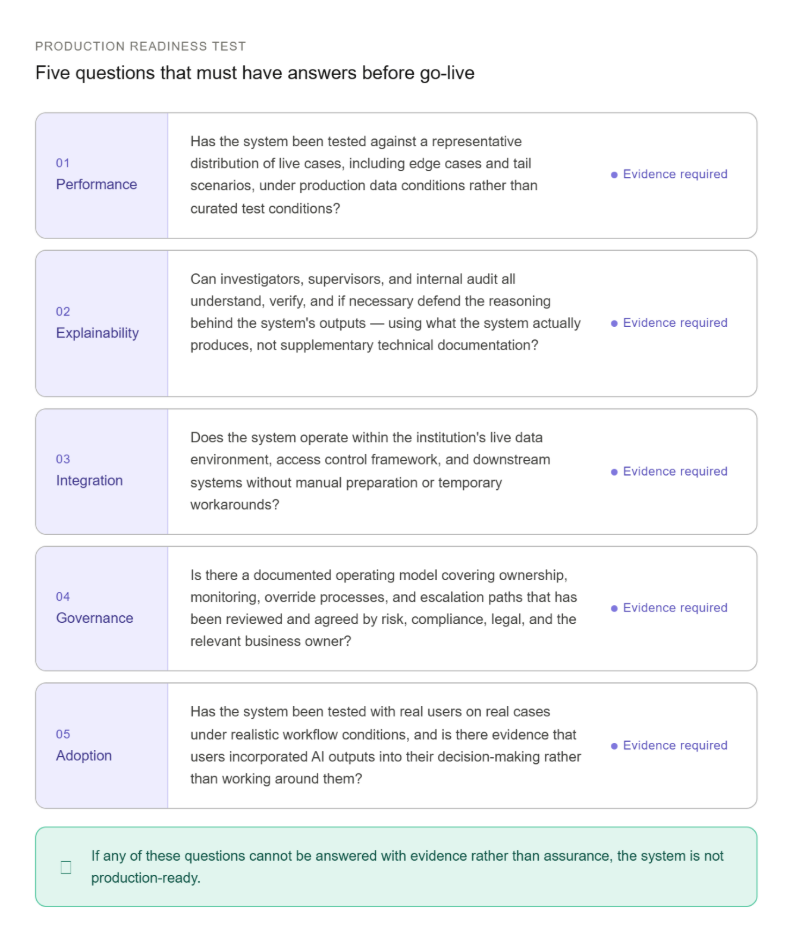
- Production readiness in financial services has five distinct dimensions: performance under real conditions, explainability at an operational level, integration completeness, governance and audit readiness, and human adoption
- Each dimension has specific, testable criteria, and most AI evaluations only test the first one
- The consequence of deploying AI that meets a demo standard rather than a production standard is not a failed pilot; it is a live system making or influencing decisions in ways the organisation cannot defend, audit, or control
- Knowing what to test, and how, is what separates a production deployment from an extended proof of concept with a go-live date
Why "production-ready" has stopped meaning anything
Ask three AI vendors whether their solution is production-ready and you will get three confident affirmative answers.
Ask them what they mean by it, and the answers will diverge considerably.
In most enterprise AI conversations, "production-ready" has come to mean "technically functional in a controlled environment." The demo runs cleanly. The accuracy numbers are strong. The interface looks finished. The vendor's implementation team has done this before.
None of that is irrelevant. But none of it is sufficient for financial services.
A regulated financial institution is not evaluating AI for its own sake. It is evaluating whether an AI system can operate within a highly constrained environment where decisions have regulatory implications, where outputs must be defensible to examiners, where data handling requirements are non-negotiable, and where the humans using the system will either trust it or route around it. The production environment is not a controlled one. It is the opposite.
The gap between early pilot success and real-world deployment is not a technical gap. It is a definitional one. Most pilots are designed to test whether AI can perform a task. Production requires evidence that the AI can perform that task reliably, governably, and at scale, under the conditions that will actually exist on day one. According to Gartner, 85% of AI projects fail to move from pilot to production — and in regulated industries, the governance and integration gaps are the most frequent reason.
Closing that gap starts with being precise about what production-ready actually means.
What production-ready AI actually means in financial services
Production-ready AI in financial services is an AI system that can perform a defined operational task reliably, at scale, within the data, regulatory, integration, and human-oversight environment of a regulated institution, without requiring continuous intervention or producing outputs that cannot be explained, audited, or defended.
That definition has five components, each of which can be tested independently.
Dimension 1: Performance under real conditions
In one sentence: A production-ready AI system performs consistently across the full distribution of live cases, including edge cases and tail scenarios, not just the clean middle of the test set.
What it means
A model that performs well on curated test data is not yet production-ready. It is a model that has been tested against the best-case version of the problem it is meant to solve.
Production conditions in financial services are materially different from pilot conditions. Data is messier. Cases are more varied. Volumes fluctuate. Edge cases arrive without warning. The business context shifts as regulations change, portfolios evolve, and customer behaviour moves.
A production-ready AI system must demonstrate that its performance holds, not just in aggregate, but across the full distribution of cases it will actually encounter. That includes the difficult, the ambiguous, and the genuinely novel.
How to test it
Replace curated data with representative data. The test set should be constructed to reflect the actual distribution of cases in the live environment, including tail cases, unusual patterns, and historically underrepresented scenarios. If the model has only been tested on clean, well-labelled data, it has not been tested for production.
Test performance degradation over time. A model that performs at 94% accuracy in month one may perform at 81% in month six as the data environment drifts. Model drift is one of the first things that breaks when AI is deployed in banking, and it is almost never visible in a pilot. Demand evidence of how the system detects drift and what triggers retraining or escalation.
Stress-test edge cases explicitly. Design scenarios that the model is unlikely to have been optimised for: low-confidence inputs, conflicting data signals, regulatory jurisdictions that generate unusual case characteristics, and volumes significantly above or below the baseline. How the system behaves at its limits is more informative than how it performs in the middle of the distribution.
Evaluate false negative costs, not just false positive rates. In financial crime compliance, a missed true positive is not a statistical outcome. It is a potential regulatory breach. Most AI metrics in banking are measured at the aggregate level, which obscures the asymmetric cost of different error types. Production readiness requires understanding the cost of each failure mode, not just the overall error rate.
Dimension 2: Explainability at an operational level
n one sentence: An AI system is operationally explainable if investigators, supervisors, and regulators can each understand, verify, and defend its outputs using what the system actually produces, without needing technical documentation.
What it means
Explainable AI is a term that has been applied to a wide range of capabilities, from statistical feature importance to natural language case summaries. In financial services, the relevant definition is operational: an AI system is explainable if the people who use it, review it, and are accountable for it can understand, verify, and if necessary, defend the reasoning behind its outputs.
This is a higher bar than technical interpretability. A model that can produce a list of contributing features is technically interpretable. A model whose outputs an analyst can use to write a defensible case file, and whose reasoning a supervisor can review in thirty seconds, is operationally explainable. The distinction matters because regulators and internal audit will evaluate the latter, not the former.
How to test it
Test with the actual users, not the technical team. Explainability that satisfies a data scientist is not the same as explainability that satisfies a sanctions investigator or a credit analyst. Present the model's outputs to the people who will use them daily. Ask them whether they can understand what the model did, whether they can verify the reasoning, and whether they would be comfortable putting their name on a decision supported by that output.
Assess the audit trail independently. AI decisions in compliance workflows must be auditable, meaning that a decision made today can be reconstructed and examined six months or two years later. Test whether the audit trail captures what the model considered, what it concluded, and what confidence level it assigned, at a level that would satisfy an internal audit review or regulatory examination.
Ask the supervisor question. Can a team leader reviewing a case understand in under sixty seconds what the AI contributed to that case, whether the contribution was reasonable, and whether the human analyst's decision was appropriately calibrated to the AI output? If the answer requires a technical explanation, the explainability does not meet a production standard.
Test regulatory defensibility explicitly. For workflows governed by FCA guidance, EU AI Act requirements, or SR 11-7 model risk management principles, explainability has a specific meaning. Operationalising AI risk governance requires that outputs meet the standard expected by the relevant regulatory framework, not just a general transparency standard. The FCA's Model Risk Management Principles for Banks (PS5/23) sets out explicit expectations for how model outputs should be explained and challenged, including requirements for independent validation and ongoing monitoring. Test against the framework that applies to your specific workflow and jurisdiction.
Dimension 3: Integration completeness
n one sentence: A production-ready AI system operates fully within the institution's live data environment, access control framework, and downstream systems, with no manual preparation or temporary workarounds.
What it means
An AI system is not production-ready if it can only operate with manual data preparation, workaround data feeds, or temporary integrations that bypass standard security and access controls.
Production integration in financial services means the AI system receives data from, and returns outputs to, the systems that govern the actual workflow. It operates within the organisation's data classification and access control framework. It handles the volume, latency, and format variability that exist in the live environment without requiring bespoke preparation or manual intervention.
This sounds obvious. It is surprisingly rare in AI deployments that have been declared production-ready by vendors.
How to test it
Remove manual data preparation and retest. If the pilot relied on an analyst cleaning or pre-processing inputs before they reached the model, the integration is not complete. Test the system with raw data as it would arrive from upstream systems, at the format and quality level that actually exists in production.
Test at production data volumes. A system that processes fifty cases per day in a pilot may not have been tested at five thousand. Latency, throughput, and queue management behaviour at scale are integration properties, not model properties. They will not be visible until the volume is real.
Validate against security and access control requirements. Financial institutions operate under strict data classification requirements. The AI system must be able to access only the data it is permitted to access, handle that data in accordance with the relevant classification standards, and return outputs to systems that are authorised to receive them. This is not a configuration detail. It is a production requirement that has caused significant deployment delays when left until late in the implementation.
Map every dependency. Production AI systems in banking sit within an ecosystem of upstream data sources, downstream case management systems, workflow orchestration tools, and compliance platforms. Understanding what breaks first in a banking AI deployment almost always involves an integration dependency that was identified but not resolved before go-live. Test each dependency independently, then test the system end-to-end with all of them active simultaneously.
Dimension 4: Governance and audit readiness
In one sentence: A production-ready AI system has a documented operating model covering ownership, monitoring, override processes, and escalation paths, agreed by risk, compliance, legal, and the relevant business owner before go-live.
What it means
An AI system that makes or influences decisions in a regulated financial institution is subject to the same governance requirements as any other decision-making process in that institution. That means model risk management, change control, ongoing monitoring, and clear accountability for the decisions the system supports.
Production-ready AI is not just a deployed model. It is a deployed model with an operating model wrapped around it: defined ownership, documented controls, monitoring thresholds that trigger review, a change management process, and a clear escalation path when the system encounters a case it cannot handle.
How to test it
Test the monitoring framework, not just the model. AI governance in financial services requires that models are monitored continuously after deployment, not reviewed quarterly. Before go-live, test whether the monitoring infrastructure is in place: performance dashboards that reflect production metrics rather than pilot metrics, alerting thresholds that trigger when performance degrades, and a process for human review when alerts fire.
Document the accountability structure. Who is responsible if the model produces a materially incorrect output that influences a consequential decision? This is not a hypothetical. It is a governance requirement. The answer should exist in writing, agreed by risk, compliance, legal, and the relevant business owner, before the system goes live.
Test the override process. Every production AI system in financial services needs a clear, tested mechanism for a human to override the model's output. The override process should be simple enough that it is actually used, documented well enough that it creates an audit trail, and designed in a way that does not create perverse incentives for investigators to avoid overriding even when they should. Test it with real users before go-live.
Validate model documentation against SR 11-7 or equivalent. For banks operating under Federal Reserve model risk management guidance, the AI system and its integration need to be documented to a standard that would satisfy a model validation review. This includes documentation of model purpose, limitations, validation methodology, and ongoing monitoring approach. The Federal Reserve's SR 11-7 guidance on model risk management defines a model as any quantitative method or system that transforms inputs into consequential outputs — a definition that encompasses most AI systems used in banking decisions today. The same principle applies under FCA guidance and the EU AI Act's requirements for high-risk AI systems.
Dimension 5: Human adoption
In one sentence: A production-ready AI system has been tested with real users on real cases, with evidence that investigators and supervisors incorporated AI outputs into their decision-making rather than working around them.
What it means
An AI system that is technically complete, explainable, integrated, and governed is still not production-ready if the people who are meant to use it will not.
Adoption is the most frequently underestimated dimension of production readiness, in part because it is the hardest to test before go-live and in part because it tends to be framed as a change management challenge rather than a product readiness challenge.
It is both. But in financial services, the adoption question also has a specific technical dimension. Investigators, analysts, and supervisors will adopt AI outputs into their decision-making when those outputs are accurate, explainable, and timed correctly within the existing workflow. When any of those conditions are not met, they will find workarounds, not out of resistance, but out of professional obligation.
A supervisor who cannot understand why the AI flagged a case will not use the output to inform their review. An investigator who finds that acting on the AI's summary adds steps to their workflow rather than removing them will revert to manual review. These are not cultural problems. They are design problems. And they become visible only when the system is tested with real users on real cases.
How to test it
Run a structured user acceptance test with representative users. Not a demo. Not a walkthrough. A live session where investigators, analysts, and supervisors use the system to process real cases under realistic conditions, with the researcher observing what they do rather than what they say.
Measure workflow integration, not just satisfaction. Whether users say they would use the system is a weak signal. Whether they actually changed their behaviour during the test is a strong one. Watch for whether users incorporated the AI output into their decision or treated it as a reference they verified manually. Understanding how AI changes investigation workflows in banking requires looking at actual workflow behaviour, not survey responses.
Identify points of friction before they become patterns. Every moment in the user test where a participant pauses, asks a question, or clicks somewhere unexpected is a signal. These friction points, addressed before go-live, prevent the adoption failures that compound after deployment when they are much harder to fix.
Test with edge cases and difficult cases, not just standard ones. Investigators trust AI systems that perform well when it matters most. A user test that only covers straightforward cases will produce artificially high satisfaction scores. Include the cases that are genuinely ambiguous, where the AI's output is uncertain or conflicts with the investigator's initial read. How the system communicates uncertainty is a critical adoption signal.
The production readiness test: five questions that must have answers
What happens when the bar is set too low
The consequences of deploying AI that meets a demo standard rather than a production standard in financial services are not theoretical.
A system that performs differently on live data than it did on curated test data will produce outputs that supervisors cannot rely on, eroding trust faster than it was built. A system whose explainability is sufficient for a data scientist but not for an investigator will be ignored by the people it was designed to support. A system without a functioning governance model will create accountability gaps that become visible only when something goes wrong.
The four failure modes that appear most frequently in AI risk incidents: data bias, hallucinations, model drift, and uncontrolled outputs, are all more likely to surface in production than in a controlled evaluation. That is precisely why the production readiness bar exists. Not to slow deployment, but to ensure that deployment does not create a problem that is more expensive than the one it was meant to solve.
AI vs automation in banking involves a different risk profile for each approach. For AI systems that exercise judgement or influence decisions in compliance-sensitive workflows, the cost of getting production readiness wrong is not a failed deployment. It is a live system operating below the standard the institution is accountable for.
The distinction between production-ready and production-deployed
One of the most important conversations banks can have with their AI vendors and implementation partners is the distinction between a system that has been deployed to production and a system that is ready for production.
These are not the same thing. A system can be technically live (running in the production environment, receiving real data, generating real outputs) while still failing to meet the five dimensions above. In many cases, the most significant gaps only become visible after deployment, which is the least productive time to discover them.
What to look for in an AI implementation partner in banking includes the willingness to define production readiness in terms of outcomes rather than milestones. A partner that declares a system production-ready based on a successful go-live date is measuring the wrong thing. The right measure is whether the system is performing, explainable, integrated, governed, and adopted, in the live environment, after the implementation team has left.
That is the standard financial services organisations should hold their AI deployments to. Not because it is convenient, but because it is the standard that the operational and regulatory environment actually requires.
How LatentBridge approaches production readiness
At LatentBridge, production readiness is not a milestone at the end of an implementation. It is a design constraint from the beginning.
Every AI Lab engagement is scoped around the five dimensions above: performance validated against real workflow data, explainability designed for the investigator and supervisor rather than the technical team, integration built within the institution's live data and security environment, governance defined before the first line of production code is written, and adoption tested with real users before go-live.
Our AI Labs workflows, covering sanctions alert triage, KYC and client onboarding, and collections and dunning intelligence, have each been designed around the specific performance, explainability, and governance requirements of the regulated environments they operate in. The definition of production-ready is different for a sanctions L1 triage workflow than it is for a KYC due diligence workflow, and the testing framework reflects that.
If you are evaluating AI for a regulated financial services workflow and want to understand what production readiness looks like for your specific context, speak with our team or explore the LatentBridge AI Labs methodology.