


At A Glance
Despite record investment in AI, most finance functions in banking and financial services are still spending the majority of their capacity on operational work: processing invoices, chasing unmatched payments, running manual reconciliations, and preparing reports. The opportunity in 2026 is not simply to automate those tasks faster. It is to redesign the underlying processes, address accumulated process debt, and sequence AI deployment where the economics are most proven, starting in procure-to-pay, order-to-cash, and record-to-report, so that finance teams can redirect their attention to the strategic and analytical work that genuinely influences business outcomes. The CFOs moving fastest are not the most enthusiastic about AI in the abstract. They are the most disciplined about foundations: data quality, process design, governance architecture, and measurable outcomes over activity metrics.
There is a paradox sitting at the heart of most finance functions in banking and financial services today. The institutions that process trillions in transactions daily, institutions that have in many cases invested hundreds of millions into technology over the last decade, still close their books in ten or more days. Their accounts payable teams still manually key invoices. Their cash application teams still spend significant portions of their week chasing unmatched remittances. And somewhere in the middle of all of this, a CFO is trying to answer a board question about margin compression while their best analysts are buried in a reconciliation backlog.
This is not a story about technology failure. It is a story about sequencing, and about one of the most important strategic questions facing finance leaders in 2026: how to move from AI experimentation to operational transformation that actually shows up in the numbers.
From Scorekeeper to Strategist: A Shift That Is Finally Happening
The redefinition of the CFO role has been discussed for years, but the data suggests it is now genuinely accelerating. According to Deloitte's Q4 2025 CFO Signals Survey, 87% of CFOs believe AI will be extremely or very important to their finance department's operations in 2026. Only 2% say it will not matter. Meanwhile, 50% of North American CFOs named digital transformation of finance as their single top priority for the year, overtaking enterprise risk management for the first time in recent memory.
This is consistent with what Deloitte's Finance Trends 2026 research found separately: 57% of finance leaders now play a lead role in shaping enterprise strategy. Finance is no longer positioned as a reporting and control function. It is increasingly one of the enterprise's primary decision-making engines, expected to weigh in on acquisitions, technology investment, operational redesign, and regulatory navigation simultaneously.
The expectations that come with that expanded mandate are genuinely demanding. Boards expect growth. Investors expect discipline. Regulators expect stronger controls. Business leaders expect faster decisions. And markets continue to demand resilience. The challenge is not that any one of these priorities is unreasonable. The challenge, as Gartner's latest CFO research notes, is that cost optimisation, improved forecasting, and funding growth opportunities all rank among the top priorities for finance leaders entering 2026. CFOs are being asked to invest and conserve, accelerate and govern, innovate and protect at the same time.
What is notable is not the ambition but the specificity of what finance leaders now want to do with AI. More than half (54%) of CFOs surveyed by Deloitte say integrating AI agents into their finance departments will be a transformation priority. That represents a meaningful shift from cautious exploration to active deployment.
Zane Rowe, CFO of Workday, captured the mood well in a December 2025 interview with Fortune: "Most of the focus has been on experimentation and discovering the art of the possible, but this year, leaders will shift from 'What can AI do?' to 'How do we build the foundation for scale?'"
That question sits at the centre of the most important conversations happening in finance today. And building that foundation, as the evidence makes clear, begins in the back office.
The Operational Reality Beneath the Strategic Ambition
Ask any CFO in a large BFS institution where their finance team's time actually goes, and the answer tends to be consistent across geographies and sub-sectors. A substantial portion of effort goes into producing information rather than interpreting it, into gathering, validating, reconciling and formatting data before any genuine analysis can begin.
This is not a failing. It reflects the reality of running a large, complex finance function with significant regulatory obligations. But it does create a structural tension between the strategic role CFOs are increasingly expected to play and the operational effort required to keep the function running day to day. As Deloitte's human capital research notes, many organisations are still designing work for people and technology separately, and the lack of intentionality in connecting the two is leaving AI investment without clear operational impact.
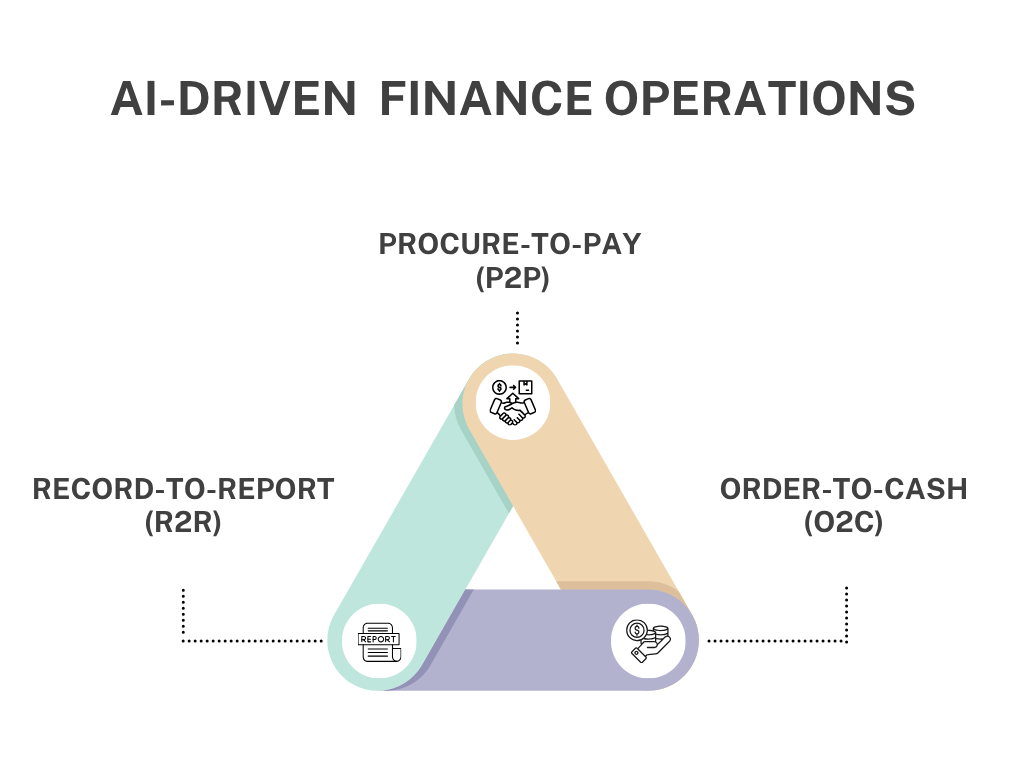
Consider what that tension looks like in practice across the three cycles that define how money moves through an organisation.
In Procure-to-Pay, the gap between what is typical and what is achievable is significant. Touchless processing rates, the proportion of invoices that flow end-to-end without human intervention, sit at 25 to 35% for most organisations. Leading practitioners achieve 70 to 90%. The cost per invoice processed manually is estimated at $10 to $15; at best-in-class organisations with AI-enabled automation, that figure falls to $1 to $3. Invoice cycle times of 8 to 11 days are common, against a best-in-class standard of under two days. In a large bank or insurer processing tens of thousands of invoices per year, these numbers represent substantial operational drag and a measurable working capital cost.
In Order-to-Cash, cash application auto-match rates of 50 to 65% mean that a significant proportion of incoming payments still require a human to find, interpret and apply them to the correct account. Leading organisations have pushed this above 85%. The downstream effects of low match rates, unapplied cash on the balance sheet, collector time diverted to investigation rather than recovery, and DSO stretched further than necessary, compound over time in ways that are often felt but rarely quantified.
In Record-to-Report, close cycles of 8 to 12 working days remain common across the industry. The best-in-class benchmark sits at 3 to 5 days. That gap is not primarily a technology problem. It reflects accumulated workarounds: manual journals created to address system limitations, reconciliations that depend on expert knowledge to navigate, and variance explanations drafted from scratch each period even when the underlying drivers change rarely.
McKinsey's State of AI research in 2025 found that organisations which fully redesigned their workflows around embedded AI were beginning to see measurable EBIT impact. The issue is not whether AI can close these gaps. It demonstrably can. The opportunity is in creating the conditions for it to do so at scale.
Understanding Process Debt: The Hidden Variable in Finance AI
One of the most important concepts emerging from finance transformation programmes today is what practitioners are beginning to call process debt.
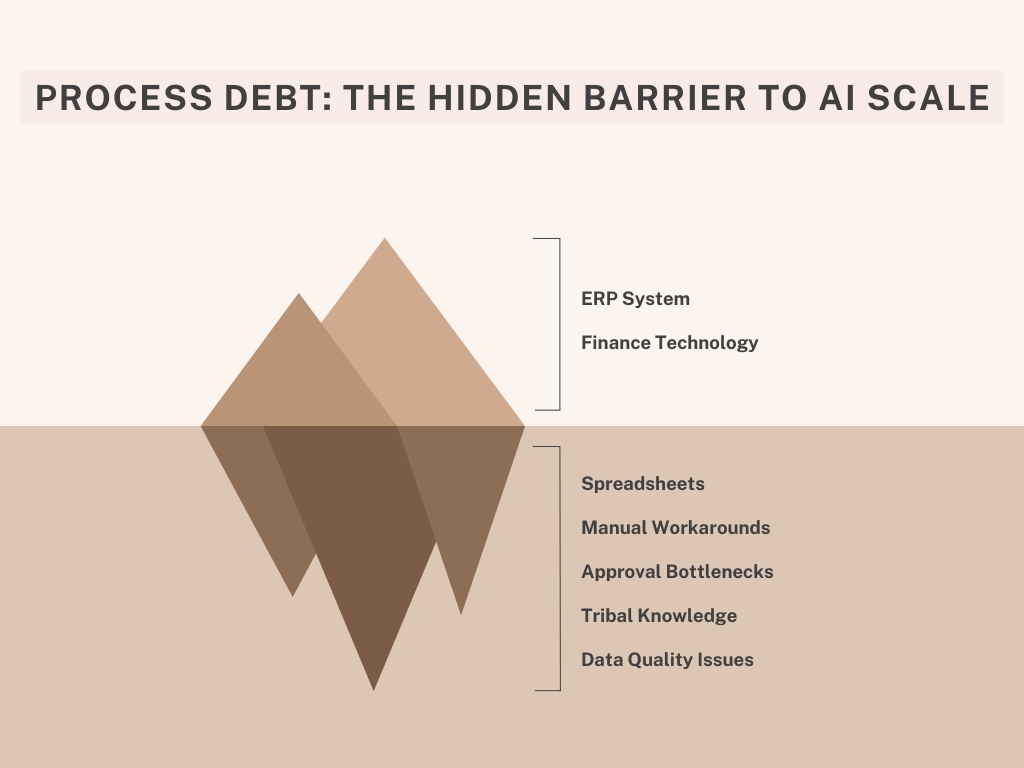
Process debt describes the accumulated weight of manual workarounds, spreadsheet dependencies, approval bottlenecks, duplicate activities, and outdated operating practices that build up around otherwise capable ERP systems over time. It is often invisible until something changes: a key individual leaves, a system upgrade exposes the workarounds, or an AI programme stalls because the data it needs does not exist in a reliable, structured form.
KPMG's Voice of the CFO report, published in September 2025, reflects this reality clearly. CFOs sharing early experience with AI described the challenges that preceded it: "Getting data right is the perennial challenge. Others struggle with dated technology." The report found a clear consensus that process and data foundations need to be addressed alongside AI deployment, while also noting that imperfect conditions should not become a reason for indefinite delay.
A simple diagnostic question helps surface where this debt lives: if several of your most experienced finance professionals left tomorrow, which processes would become difficult to operate? The answer tends to reveal exactly where operational dependency still resides, and where AI deployment will either find a clear path or encounter structural friction.
Bain and Company's CFO Survey 2026 found that only 15 to 25% of CFOs have fully scaled AI in their finance departments. Among those that have scaled, 41% report being satisfied with outcomes, compared to 25% of those still in pilot mode. Bain's observation of the current state is direct: "The close takes longer than it should. Forecast refreshes lag the business. Finance still runs on spreadsheets."
The strategic implication is that AI deployment and process redesign are most effective when they happen together. The organisations achieving the strongest results are not automating existing processes as they stand. They are using the AI programme as an opportunity to rethink how the process should work, and then building the automation around the redesigned version.
It is also worth noting what Deloitte's Finance Trends 2026 research found: while 63% of finance teams report actively using AI solutions, only 21% say those investments have delivered clear and measurable value so far. Gartner reached a similar conclusion in mid-2026, noting that CFOs must distinguish between AI deployment and AI value creation. One measures activity. The other measures impact. That distinction is increasingly where the real conversation lies.
What Is Actually Working: Evidence from the Field
The encouraging reality is that where organisations have addressed their operational foundations, the results are measurable. And increasingly, the evidence is coming from CFOs speaking publicly about what they have built and how.
Hewlett Packard Enterprise's CFO Marie Myers has been one of the most candid voices on this topic. In a February 2026 interview with CFO Dive, Myers described how HPE developed an internal agentic AI tool called Alfred, built in collaboration with Deloitte, and now in production across multiple finance workflows. The tool is deployed on what she describes as the "transactional side of finance," from credit and collections to accounts payable and receivable processing. Her framing of the ambition reflects a broader shift in how leading finance organisations are thinking: "In 2026, CFOs need to shift from financial gatekeepers to transformational architects who drive strategy and shape decisions."
Alphabet's CFO Anat Ashkenazi offered a concrete illustration on the company's Q4 2025 earnings call. The finance department is using agentic AI to automate invoice payment and reconciliation, and deploying it within the treasury function. The internal automation push, she said, extends "all the way from the engineering team to small teams within our back office, even with my finance team." Alphabet is among the organisations where AI in finance is no longer being discussed as a future possibility. It is running in production.
These examples share a common pattern that Bain's research validates: results are strongest in transactional finance, particularly invoice-to-cash and procure-to-pay, even as investment attention is beginning to shift toward FP&A and financial reporting. The pragmatic path Bain recommends is to first industrialise value streams where the economics are proven, then expand with a mature scaling engine in place.
Marie Myers put this sequencing plainly in her Fortune interview: "AI isn't on the horizon; it's here. In 2026, AI will move beyond experimentation to become a core enabler of finance operations. For HPE, that means our intelligent agents will automate quarterly close, forecasting, and analysis, delivering real-time insights and actionable predictions."
The Agentic Shift: More Than a Technology Upgrade
If the first wave of AI in finance was about automating discrete, well-defined tasks, the wave now building is structurally different. Agentic AI systems do not simply execute instructions. They plan, reason, and execute across complex multi-step workflows, handling exceptions and making context-aware decisions with minimal human oversight.
For finance operations, this matters because the most time-consuming work in a typical finance function is not the routine processing. It is the exceptions: the invoices that do not match, the payments that arrive with incomplete remittance detail, the reconciliation items that do not clear automatically. Conventional automation tools escalate exceptions to a human queue. Agentic systems can reason through the most likely resolution and act, flagging only the cases where genuine human judgment is required.
KPMG's August 2025 Voice of the CFO report captures where most serious finance functions currently sit: "We're seeing a lot of productivity, but we're not seeing headcount reductions yet." That is an honest near-term description, and it is not a disappointment. Productivity gains reinvested into analytical capacity and risk oversight represent genuine value, even before structural headcount changes become visible. The more immediate benefit is the reall
ocation of senior finance talent from operational triage to the kinds of decision support, scenario modelling, and business partnering that CFOs increasingly want their teams to be doing.
BCG's AI Radar 2026 found that spending on AI is set to double as a share of revenue, with 94% of organisations planning to continue investing. BCG is equally direct about the performance divide forming in financial services: pioneers in AI adoption are projected to gain a 4% return on tangible equity advantage over slow movers. In an industry where a single percentage point of ROTE is hard won, that is a consequential gap.
Controls, Governance, and the Trust Architecture
In banking and financial services, governance is a first-order constraint, not a secondary consideration. For CFOs deploying AI in finance processes, this means building what might be called a trust architecture from the outset rather than retrofitting it after the fact.
There are three dimensions of governance that are particularly important in a BFS context.
Auditability is the first. Every decision made by an AI system operating in a finance context, whether matching a payment, approving an invoice, or flagging a potential duplicate, needs to be traceable in a form that an auditor or regulator can interrogate. This is not a technical afterthought. It is a design requirement that needs to be specified before deployment begins.
Model risk is the second. Banks have operated model risk management frameworks for quantitative models for years. The same rigour needs to be applied to AI models operating in financial processes: what are the training data sources, what is the refresh cycle, and how is performance degradation detected? Internal audit functions and external regulators are asking these questions with increasing frequency.
Accountability is the third. When an AI system makes an error in a finance process, who is responsible? This requires a clear operating model decision about where human oversight sits, what triggers human intervention, and how accountability is documented. Future CFO's May 2026 research found that 55% of CFOs are concerned about the loss of human judgment and oversight in AI-enabled processes, and that concern is entirely reasonable. The right response is governance by design, not governance as a barrier to progress.
Niall Byrne, CFO of Qatar Investment Authority, articulated the approach many leading finance organisations are taking in a 2025 World Economic Forum interview: "We are exploring pilot projects with clear metrics to help quantify the return on investment on AI investments, including looking at adoption rates, data processing speed, value creation and employee productivity — the success of these pilots will help guide us in our AI journey." The emphasis on clear metrics and staged decision-making reflects an approach that treats governance not as a reason to avoid AI, but as a design input to how it is responsibly deployed.
What Separates Organisations That Scale from Those That Stall
BCG's Center for CFO Excellence surveyed over 280 finance executives with AI experience in March 2025. The finding on median ROI in finance AI is instructive: 10%, well below the 20% most organisations are targeting, with nearly a third reporting only limited gains. Understanding why that gap exists is one of the most important strategic questions facing CFOs in BFS today.
The pattern that emerges from BCG's data, and which Bain and McKinsey's parallel research corroborates, is consistent. Organisations achieving strong AI returns in finance tend to do a small number of things differently.
They sequence deliberately, starting in transactional areas where data is relatively clean, processes are well understood, and outcomes are measurable: invoice processing, cash application, bank reconciliation. They resist the temptation to begin with the most strategically interesting application before establishing confidence in the data and operational foundations. Early wins fund later ambition.
They treat AI deployment and process redesign as a single programme rather than separate workstreams. The opportunity to address process debt and redesign how work is done is most accessible at the point of AI implementation. The organisations that capture it tend to achieve structurally better outcomes than those that automate existing processes as they stand.
They define and track operational metrics before deployment: touchless rate, auto-match rate, close duration, exception volume. The organisations reporting highest satisfaction with AI in finance are those that held their programmes accountable to improving specific numbers, not just to completing implementation.
They involve audit and controls as design partners from the beginning, not as a governance gate at the end. In BFS, internal audit functions have the standing to accelerate or constrain AI deployment depending on how well they understand what they are being asked to sign off on. Early involvement consistently produces better outcomes than late-stage review.
And they treat the talent question with the same seriousness as the technology question. Gartner's early 2026 survey of CFOs identified building AI talent within the finance function as the most pressing near-term challenge, ahead of both technology and budget. As Amy Butte, former CFO of the New York Stock Exchange and current CFO of Navan, has observed, finance leaders need to focus on outcomes rather than activity, measuring AI's value through tangible business impact rather than adoption metrics alone.
The goal, as this body of evidence consistently points toward, is not automation for its own sake. It is creating human capacity for better decisions.
The Strategic Questions Worth Asking Now
For CFOs and finance controllers in banking and financial services, the following questions are worth putting to your leadership team, not as a checklist, but as the basis for a genuine strategic conversation.
Where does your finance team's time actually go? How much of your function's capacity is consumed by operational process, gathering, validating, processing and formatting information, versus by genuine analytical or advisory work? If that proportion is not clearly understood, the starting point for any AI programme is measurement.
Where does your process debt live? Which processes depend on spreadsheets that no system owns? Which workflows rely on institutional knowledge held by a small number of individuals? These are the areas where AI deployment will encounter friction, and they are also often the areas where the returns from addressing them are highest.
What is your sequencing strategy? Bain's guidance to start where the economics are most proven, in invoice-to-cash, procure-to-pay, and the accounting close, is grounded in what is actually working in 2026. The most practical use case and the most strategically visible use case are often different. Starting with the former tends to produce more durable results.
What does your governance architecture look like? In a regulated financial institution, AI governance for finance processes is not a lightweight exercise. The institutions moving fastest are those that have established clear frameworks for auditability, model risk, and accountability before scaling.
What does success look like, specifically? Gina Mastantuono, President and CFO of ServiceNow, put it plainly in her December 2025 forecast for Fortune: "In 2026, AI will be judged less on promise and more on proof. Enterprises will continue to expect measurable gains in speed, resilience, and decision quality, not pilots and prototypes."
That standard is the right frame for evaluating where to invest next.
Looking Ahead: The Competitive Divide Is Already Forming
Bain's 2026 CFO research makes a point worth sitting with: "The competitive divide is forming now. The question is which side of it each organisation chooses to be on."
In a sector where margins are under structural pressure, where regulatory costs are rising, and where the best finance talent increasingly needs to be directed to higher-value work, the finance functions that automate their operational baseline will have a structural cost and speed advantage over those that continue to run on manual workarounds. KPMG's estimate that agentic AI could contribute $3 trillion in corporate productivity, based on research across more than 17 million companies, reflects the scale of the structural shift underway.
McKinsey's December 2025 scenario analysis on banking and AI concluded that in the most likely future state, AI agents become a meaningful channel for specific financial functions while customers continue to value direct institutional relationships for complex matters. The implication for BFS finance leaders is straightforward: AI will not replace the judgment that matters, but it will meaningfully advantage the organisations that have freed their finance teams from the work that does not require judgment at all.
The CFOs best positioned for the next phase of this transformation are those with a clear picture of what their finance operations actually look like today, the process debt, the data gaps, the reconciliation backlogs, and the discipline to sequence their investment around the areas where both the need and the evidence of impact are strongest.
The back office, unglamorous as it is, is where that story begins. And for the finance functions that get this right, the returns will show up well beyond the back office itself.
Join the Conversation: LatentBridge Executive Roundtable, London
LatentBridge is hosting an invitation-only Executive Breakfast Roundtable in the City of London on 10 June 2026, from 8:00am to 10:30am.
This is a closed-room conversation for CFOs, Finance Controllers, and AI Transformation Leaders in banking and financial services, focused on the question that matters most right now: how do finance organisations move from AI experimentation to operational outcomes that are measurable, auditable, and scalable? The discussion will be grounded in the three core finance cycles, procure-to-pay, order-to-cash, and record-to-report, and will draw on the practical experiences of peers who are navigating exactly these challenges today. No presentations. No vendor pitches. Just a direct, peer-level exchange on what is working, what is not, and what the next meaningful step looks like.
Places are limited. To express your interest, register below and full event details will be confirmed by email.