



At A Glance
- A successful AI pilot establishes technical feasibility. Scaling requires evidence that the improvement holds across the complete business workflow and delivers an acceptable return.
- Business outcomes should determine what gets scaled. Productivity, operational capacity, cost savings and revenue contribution are related, but they are not interchangeable.
- Production expansion needs explicit acceptance criteria covering quality, reliability, controls, integration, adoption and economics.
- Reusable architecture should reduce the cost and effort of subsequent deployments without removing workflow-specific requirements.
- Enterprise leaders need to manage AI investments as a portfolio of operating capabilities, with accountability for realised value and ongoing performance.
Connecting AI productivity to business performance
Consider a corporate bank introducing AI into its client onboarding process. The initial implementation delivers encouraging results. Document extraction takes less time, analysts can prepare information more efficiently, and the solution performs reliably against the cases used for evaluation.
The improvement creates a reasonable basis for further investment. However, its contribution to the bank's operating performance depends on what happens beyond document preparation. Cases may still wait for compliance reviews, additional information from clients or approvals from other teams. The bank may have reduced the time spent on one activity without materially changing the time required to complete onboarding.
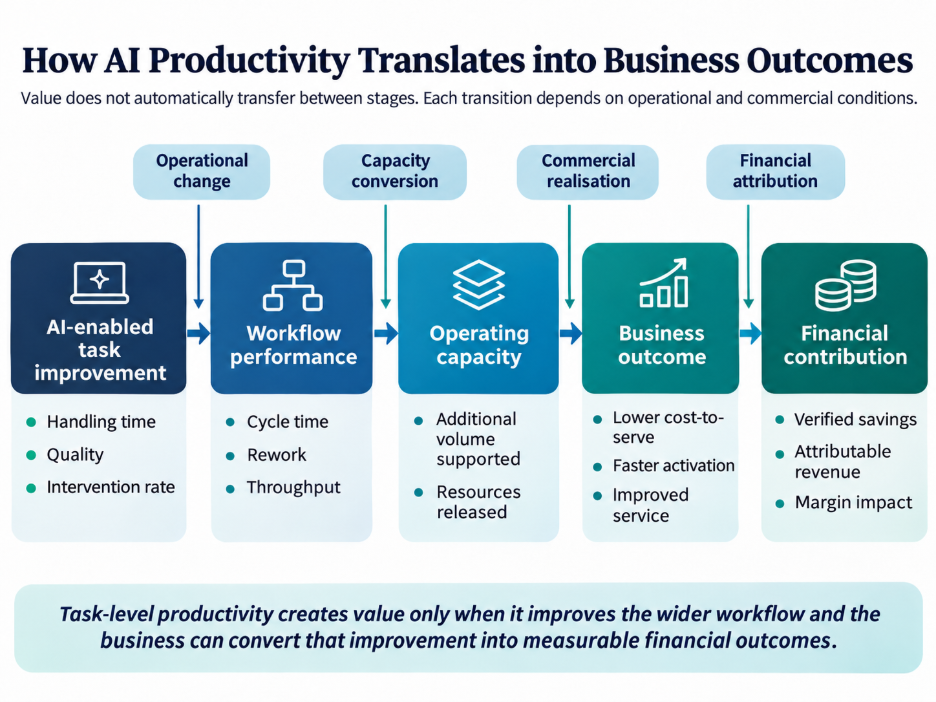
This distinction becomes increasingly important as AI programmes expand. Productivity improvements are often reported at the level of individual employees or tasks, while investment decisions are made against broader objectives involving operational capacity, cost, revenue and risk.
McKinsey's 2026 State of AI research found that only 6% of surveyed organisations qualified as AI high performers, reporting significant value and at least 5% EBIT impact attributable to AI. The finding highlights the distance between implementing AI capabilities and demonstrating a material financial contribution from them.
For LatentBridge, that distinction shapes how scaling should be approached. A technically successful implementation establishes what the technology can do within a particular workflow. Expanding that implementation requires a clearer understanding of the operating conditions, organisational dependencies and financial outcomes that determine whether the improvement can be sustained.
An enterprise may introduce AI into several departments and achieve measurable productivity improvements without seeing an equivalent change in overall business performance. The benefits may remain concentrated within individual teams, be absorbed by existing process constraints or require further operational changes before they can be realised.
A sound scaling programme therefore needs to connect AI performance with the economics of the wider workflow. This involves establishing where value is created, identifying the dependencies that influence its realisation and developing the engineering and operating capabilities needed to reproduce successful outcomes.
Building the economic case for enterprise-wide AI
When several AI implementations demonstrate promising results, enterprise leaders face a prioritisation challenge. Each programme may have a credible technical case, but the cost, complexity and potential business contribution of expanding it can vary considerably.
A bank might be evaluating AI-assisted document review, customer service automation and research support simultaneously. The relevant investment decision depends on the operating conditions of each workflow, the measurable opportunity for improvement and the cost of delivering that improvement reliably.
In corporate onboarding, the economic case may involve reducing cost per completed case, improving processing capacity or shortening the time between client application and activation. These outcomes are related, but they depend on different operational factors.
Reducing cost per case requires an understanding of where effort is consumed across document collection, verification, investigation, approval and exception handling. Improving capacity requires identifying the activities that constrain the number of cases completed within a given period. Accelerating revenue depends on whether the onboarding process is delaying clients from accessing services that generate income.
The assessment must therefore begin with an accurate operating baseline. Case volumes, handling effort, end-to-end cycle times, exception rates, rework and fully loaded processing costs should be examined together. Where the business case includes revenue acceleration, the organisation should also establish the relationship between onboarding completion and subsequent commercial activity.
The financial treatment of released capacity deserves particular attention. Consider an illustrative onboarding operation processing 12,000 cases annually. If AI reduces manual review effort by an average of 30 minutes per case and the improvement holds across the full portfolio, the gross capacity opportunity would be 6,000 hours annually.
That capacity has potential economic value, but its financial treatment depends on how the bank uses it. It may allow existing teams to handle additional volumes, reduce overtime, avoid future recruitment or redirect employees toward more complex investigations. Each outcome affects the business differently.
When released capacity enables the organisation to avoid expenditure, the financial benefit can be assessed against the relevant cost. When it supports additional processing volumes, the bank must establish that sufficient demand exists and that downstream functions can accommodate the increase. When it accelerates client activation, any revenue contribution must be supported by evidence of earlier revenue-generating activity and the associated commercial economics.
These distinctions are necessary to prevent productivity estimates from becoming overstated financial projections. They also establish the evidence that will be needed once the implementation reaches production.
Before committing to expansion, the business owner and finance team should agree on the baseline, expected sources of value, material assumptions and total implementation and operating costs. These become the reference points against which subsequent performance is evaluated.
Redesigning the workflow before expanding the technology
An established economic case provides direction for the next stage of work, but successful implementation depends on a detailed understanding of the operating process.
In large enterprises, documented procedures do not always reflect the variations encountered in daily operations. Corporate onboarding, for example, may involve incomplete submissions, complex ownership structures, inconsistent information, multiple approval authorities and requests for clarification that move cases between teams.
These variations determine how the workflow performs and where AI can contribute effectively. A solution developed around standard cases may demonstrate strong accuracy during testing while requiring substantial additional effort when exposed to more complex production workloads.
Workflow assessment should establish how information enters the process, which systems are involved, where responsibility changes hands and which activities require specialist judgment. It should also distinguish active processing time from elapsed cycle time.
An analyst may spend 30 minutes reviewing a document, while the corresponding case remains in the process for several days because of an outstanding approval or missing information. Improving the review activity will reduce handling effort, but any reduction in total onboarding time depends on whether the surrounding constraints are addressed.
This is why LatentBridge places considerable emphasis on understanding the actual workflow before determining the AI intervention. The objective is to identify which activities can be improved, how those improvements affect adjacent steps and what changes are required for the process to operate differently.
In an AI-assisted onboarding workflow, the system may extract information from submitted documents, compare it with available records and prepare supporting evidence for analyst review. Cases with straightforward requirements may need less manual preparation, while complex ownership arrangements or conflicting information may continue to require specialist investigation.
The future-state process must account for these differences. It should define how information moves into downstream systems, what evidence reviewers receive, how exceptions are identified and which decisions remain subject to human approval.
Operational teams should also determine whether the proposed intervention introduces additional work elsewhere. If employees must manually transfer outputs between applications or repeat checks because the resulting evidence is insufficient, improvements in extraction time may be offset by additional handling.
The workflow design should be validated against baseline measures for cycle time, queue time, rework, exception frequency and cost per completed case. These measures allow the implementation team to establish whether the intended changes are likely to improve overall performance rather than only individual tasks.
By the end of this stage, the business should have an agreed future-state process, defined responsibilities and measurable performance expectations. These provide the basis for engineering the solution and evaluating its production readiness.
Engineering AI for production conditions
A successful pilot offers evidence that an AI capability can perform a defined task under selected conditions. Production deployment requires the system to operate within an established technology environment, process live information, accommodate demand and maintain acceptable performance when conditions change.
For a major financial institution, that environment may include legacy applications, restrictive data access arrangements, regional operating differences, multiple security domains and business processes that require formal controls.
Production readiness therefore has to be assessed across the complete system.
In an AI-assisted onboarding implementation, the bank needs confidence that the solution can process relevant document types, retrieve authorised information, identify exceptions and produce evidence that can be used within existing review and approval procedures. Evaluation needs to include difficult cases, incomplete information and unexpected data conditions alongside standard examples.
Model accuracy remains an important measure, but it does not fully describe operational performance. The system may extract most fields correctly while failing to recognise a material ownership exception. It may produce a technically valid response that lacks the supporting evidence needed for review. It may also behave differently when connected to live data sources or exposed to higher transaction volumes.
Evaluation criteria should therefore be developed around the specific responsibilities assigned to the AI system. For document processing, this may involve field-level accuracy, evidence completeness and exception detection. For retrieval-based applications, the quality and traceability of supporting information become important. For systems permitted to initiate actions, testing must also address execution boundaries, permissions, failure handling and recovery.
The relevant acceptance thresholds should be agreed before production testing. Their stringency will depend on the workflow, the consequences of failure and the institution's risk appetite.
Operational reliability requires similar attention. Production teams need visibility into response times, throughput, service availability, integration failures and the frequency of manual intervention. They also need procedures for responding when upstream data is unavailable, an external service fails or an AI output cannot be used confidently.
Depending on the workflow, the appropriate response may involve retrying an operation, routing the case to a human reviewer, returning to an established manual procedure or temporarily suspending an automated action. These behaviours should be designed and tested rather than improvised after deployment.
Governance requirements must also be implemented within the system. Access permissions, data handling rules, authorised actions and audit evidence should be enforced through technical and operational controls. Where AI contributes to consequential decisions, the organisation needs sufficient information to reconstruct what happened and determine how a result was produced or approved.
Changes to models, prompts, integration logic or business rules can affect these controls and the system's behaviour. Version management, regression evaluation, approval procedures and rollback arrangements are consequently part of ongoing production operations.
This article on why AI pilots in banking rarely scale examines how integration, governance and operational trust influence the transition from experimentation to dependable production systems.
For expansion decisions, technical teams should provide a consolidated view of evaluation results, operational performance, control testing, failure handling and support responsibilities. Leadership can then assess whether the implementation is sufficiently reliable for the intended workload and whether unresolved risks are acceptable.
Establishing realised value in production
Production acceptance confirms that a solution can operate within agreed technical and control requirements. The next stage is to establish whether the expected business improvement is occurring under normal operating conditions.
This requires measurement across a representative workload and sufficient attention to factors that may influence the results.
In the onboarding example, case complexity, staffing, transaction volumes and downstream processing arrangements can all affect performance. An improvement observed during a period with fewer complex cases may not be representative of the broader operation. Similarly, a reduction in cycle time may reflect process changes unrelated to the AI implementation.
The evaluation approach should make these influences visible.
Task-level measures establish how effectively AI performs the activities assigned to it. In document review, these might include extraction quality, analyst handling time and the proportion of outputs requiring correction.
Workflow measures establish whether the overall process has improved. They include end-to-end cycle time, throughput, exception handling, rework, approval delays and service-level performance.
Financial measures establish whether those operational changes are creating a realised business benefit. These may include cost per completed case, expenditure avoided through released capacity, the economic value of additional processing volume and attributable contribution from earlier client activation.
The relationships between these measures are important. An improvement in extraction accuracy may reduce correction effort, which may improve case throughput. Whether that throughput creates financial value depends on demand, downstream capacity and the bank's ability to convert the additional output into a measurable commercial or cost benefit.
A credible value assessment also requires the full cost of operating the solution.
Model consumption is only one component. Integration, infrastructure, evaluation, monitoring, security, exception handling, human review, operational support and maintenance all contribute to the economics of the workflow.
Some costs are directly attributable to a particular implementation, while others support several deployments. The business case should identify both and apply a consistent method for evaluating the overall financial contribution.
For example, an implementation may produce meaningful reductions in manual handling effort but require substantial specialist review of exceptions. Another may deliver reliable performance at limited volumes but become expensive when usage increases because of inference costs or integration constraints.
These conditions influence whether expansion is justified.
The finance team should distinguish realised expenditure reductions from released capacity, incremental revenue from potential commercial opportunity, and recurring benefits from one-time improvements. The same operational gain should not be counted independently as labour savings, additional capacity and revenue contribution unless the benefits are demonstrably separate.
This makes the scaling decision more rigorous. A system that performs reliably but delivers less financial value than expected may require further workflow redesign. An implementation with attractive economics but unstable exception handling may need additional production engineering before it can expand.
The evidence should determine the next investment decision.
Replicating successful implementations across the enterprise
Once an AI-enabled workflow has demonstrated reliable production performance and acceptable economics, the organisation can assess opportunities to extend the capability.
Replication is often more complex than the original business case anticipates. Different teams may need similar functionality while operating with distinct data structures, application interfaces, permissions, business rules and approval procedures.
A solution that works well in one onboarding function may require substantial adaptation for another client segment or regional operation. The underlying technology can remain suitable while the surrounding operating environment changes.
The enterprise therefore needs to identify which capabilities can be reused and which requirements must be addressed locally.
Common infrastructure and engineering services can reduce repeated development effort. These may include enterprise integrations, identity and access management, governed data retrieval, model configuration, evaluation frameworks, workflow orchestration, logging and monitoring.
The benefit of these shared services depends on how effectively they support multiple implementations without introducing unnecessary dependencies.
A centrally managed integration component may reduce engineering effort for several business units. However, access permissions and data handling rules must still reflect the requirements of each workflow. An evaluation framework may provide common tooling while allowing different acceptance criteria for a research assistant and a financial control application.
These distinctions should be reflected in the architecture and delivery process.
In Scaling Enterprise AI Requires More Than Better Models, we've explored the relationship between platform capabilities, business ownership and governance. The practical significance becomes especially clear during replication, when shared engineering must support different business environments without weakening the controls required by each.
Replication should also be measured as an economic activity.
Enterprise leaders need to understand how much engineering effort is saved through reusable components, how long additional deployments take, what local integration work remains and how reliably the shared architecture performs across environments.
Deployment lead time, component reuse, adaptation cost, regression-testing effort and incremental operating expense provide useful evidence.
If subsequent implementations require nearly the same amount of work as the first deployment, the organisation may not yet have developed genuinely reusable capabilities. The underlying architecture may be too closely coupled to its original environment, or the common platform may not address the dependencies that consume the most delivery effort.
Conversely, high component reuse does not establish successful scaling if business performance deteriorates or control exceptions increase.
The replication programme should therefore assess delivery efficiency alongside production reliability, adoption and realised business outcomes.
The order of expansion also matters. Business units with similar workflows, information requirements and control obligations may provide a more efficient next step than environments requiring extensive redesign.
This does not imply that the easiest implementations should always take priority. It means the economic case for each expansion should account for the additional complexity involved.
The resulting programme becomes progressively more capable when shared foundations improve through production experience and subsequent deployments can build on that work.
Managing AI as an enterprise investment portfolio
As AI becomes part of operations across multiple business functions, its financial and operational management needs to extend beyond individual projects.
A bank may have several implementations delivering measurable local improvements while the overall programme carries substantial shared infrastructure, engineering, governance and support costs. Different business units may also report overlapping benefits from related process changes.
Without a consistent portfolio view, leadership can overestimate the aggregate return or overlook where the costs of scaling are increasing.
Each production workflow should therefore retain a named business owner, an agreed measurement baseline and visibility into its operating economics. At the same time, shared platform costs need to be allocated through a transparent approach that allows the institution to evaluate both individual deployments and the wider investment.
This distinction prevents a business function from appearing profitable simply because the costs of common capabilities are carried elsewhere. It also allows leadership to understand whether the shared platform is delivering sufficient value across the implementations it supports.
Portfolio management should influence investment decisions continuously.
An AI-enabled workflow may warrant expansion because it has established reliable performance, strong adoption and a measurable financial contribution. Another may require changes to the operating process because employees are not using it as intended. A third may remain technically successful but become uneconomic because of ongoing maintenance, review or integration costs.
These situations require different responses. Treating every deployed solution as a permanent capability makes it harder to direct investment toward the areas producing the strongest results.
Leadership also needs to understand how the programme contributes to established business performance measures.
In banking, relevant measures may include cost-to-income performance, cost per transaction, service capacity, customer activation, operating expense, risk-related losses and revenue contribution.
The relationship between AI and those measures must be established carefully. Revenue changes can reflect market activity, client demand, pricing, sales performance and other factors. Similarly, improvements in operating capacity may not produce immediate changes in reported expenditure.
The programme should claim the financial contribution supported by evidence and explain material assumptions where attribution is uncertain.
This creates a more credible basis for comparing AI investment with other enterprise transformation initiatives and for determining where the next funding commitment should be made.
A disciplined approach to scaling decisions
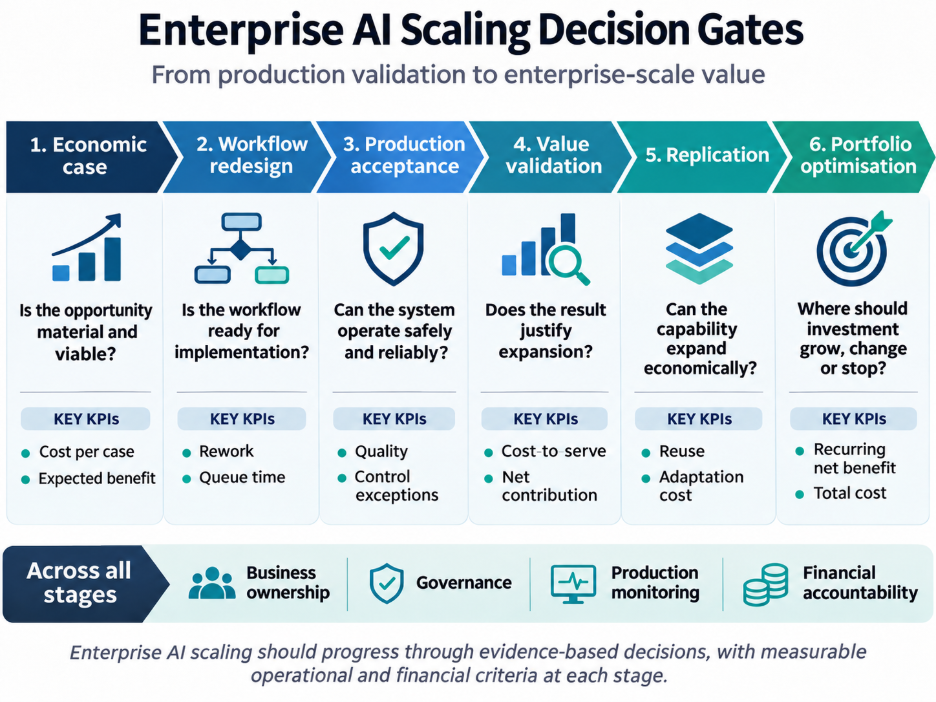
The preceding stages provide a sequence for moving from an initial business opportunity to enterprise-wide deployment. The sequence is most useful when each stage concludes with a clear decision supported by evidence.
The economic assessment establishes whether the opportunity is sufficiently material and whether the anticipated benefits justify further investment. This requires an agreed workflow baseline, defined value drivers and visibility into the expected costs.
Workflow redesign establishes whether the proposed intervention can improve the complete operating process. The evidence should include the future-state design, ownership, handling requirements, exception paths and expected changes in cycle time or capacity.
Production acceptance determines whether the solution meets the quality, reliability, security, governance and operating requirements relevant to its intended use. The necessary evidence includes realistic evaluation results, control testing, operational performance and defined support arrangements.
Value validation establishes whether the expected improvement has materialised in production. The business and finance teams should examine workflow performance, adoption, ongoing operating costs and attributable financial benefits.
Replication establishes whether the capability can be extended efficiently into additional environments. Measures such as deployment lead time, adaptation cost, reuse, reliability and control performance reveal whether common foundations are providing the expected advantage.
Portfolio optimisation brings these results together. It allows leadership to review recurring net benefits, total cost, operating performance and changes in business requirements before allocating further investment.
The acceptance criteria will vary between applications. A financial crime workflow, a research assistant and an onboarding process have different consequences of failure, operational dependencies and economic objectives. Their production and investment requirements should reflect those differences.
The benefit of a common scaling discipline is that decisions remain connected even when the individual implementations differ. A business case defines the outcome, engineering establishes the conditions for reliable delivery, production demonstrates performance, and portfolio management determines whether continued investment remains justified.
Building an enterprise capability that continues to deliver value
The expansion of AI into enterprise operations brings technology investment, process design and business accountability into closer contact.
For technology leadership, the challenge involves establishing architecture and delivery processes that can support new implementations without increasing complexity at the same rate. For business leadership, it involves making the operating changes necessary to convert AI performance into improvements in capacity, service, cost and revenue. Finance and risk functions need corresponding confidence in the measurement of benefits, visibility of costs and effectiveness of controls.
These responsibilities are closely connected in production. The economic value of a workflow depends on its operational design, while its reliability and ability to expand depend on engineering and governance decisions made earlier in delivery.
A successful implementation provides evidence that AI can improve a defined process. Enterprise scaling requires the organisation to preserve that improvement under changing operating conditions, extend it where there is a viable business case and manage the resulting capabilities over time.
The investment case becomes stronger when each deployment contributes reusable engineering, operational knowledge and reliable evidence that reduces uncertainty for subsequent implementations.
Ultimately, enterprise AI maturity is reflected in the organisation's ability to deliver improvements consistently and account for their business contribution. That capability has greater long-term significance than the number of applications deployed.
Ready to move from AI implementations to enterprise-wide results?
LatentBridge works with enterprises to identify high-value workflows, redesign operating processes and engineer AI capabilities that function reliably within complex technology and control environments.
Our focus is on connecting engineering execution, production readiness and repeatable deployment with measurable business outcomes.
Discuss your enterprise AI scaling priorities with LatentBridge