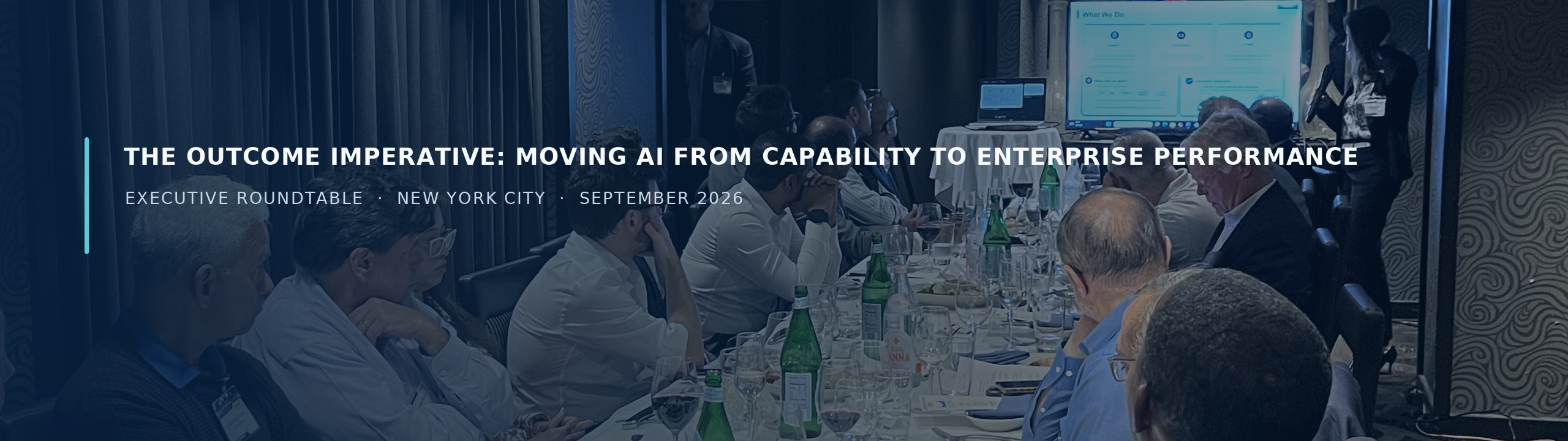
The Outcome Imperative: Moving AI from Capability to Enterprise Performance – An Executive invite-only roundtable brought senior financial services and AI leaders together to discuss what it takes to move advancing AI capability into real enterprise workflows, operating models and measurable outcomes.
NEW YORK, September 17, 2026: LatentBridge convened senior leaders from financial services and enterprise AI for The Outcome Imperative: Moving AI from Capability to Enterprise Performance, an invitation-only Executive Dinner Roundtable focused on a growing enterprise challenge: AI capability is advancing faster than many institutions can integrate it into real workflows, controls and operating models.
The session was moderated by Hema Gandhi, Founder and CEO of LatentBridge; Kosta Haritakis, Managing Director and Global Head of AI at Mizuho; and Julian Mason, Head of Investment Banking & Payments GTM at Anthropic. Participants represented global banking and financial services organizations, with responsibilities spanning AI, technology, data, risk, operations, transformation and business leadership.
Mason opened with a perspective on the AI frontier, highlighting rising model intelligence, longer task horizons, falling costs and improving reliability. He framed enterprise adoption across three parallel tracks: engineers and IT teams, business users, and “Big Rock” workflows involving substantial front-, middle- and back-office work.
Gandhi connected those advances to the practical demands of enterprise deployment. She discussed multi-step agentic workflows, process redesign and orchestration across systems, alongside the governance, cost, performance, human oversight and change management required to take AI into production. She also highlighted LatentBridge’s work on use cases spanning syndication, KYC and fee prediction, linking the “Big Rock” discussion to specific business applications.
Three themes emerged from the wider discussion.
Several banking leaders questioned whether access to the latest model remains the decisive constraint on adoption. More immediate challenges include integrating AI with existing systems, connecting enterprise data and context, redesigning workflows and establishing appropriate controls.
A recurring observation was that institutions cannot absorb new capabilities at the pace they arrive. The gap is widening between what AI models can do and what enterprises can reliably put into practice.
Participants challenged the value of large portfolios of disconnected proofs of concept. Stronger programs were described as those anchored in material business problems, clear senior ownership, measurable outcomes and a credible path to production.
That focus requires a fuller understanding of how work happens. Formal process maps often omit manual workarounds, informal handoffs and the judgment employees exercise to complete a task. Effective redesign starts by making that work visible, then determining how AI, existing automation and people should contribute to the intended outcome.
The larger opportunity often spans multiple systems and departments. Capturing it requires institutions to address the full workflow, including the decisions, dependencies and exceptions that shape performance.
As AI systems take on more responsibility, institutions need clearer permissions, stronger evidence, defined exception paths and explicit human accountability. The business case and the control model must develop together.
Participants also highlighted the value of partial automation. Its effectiveness depends on reliably distinguishing cases suitable for automation from those requiring experienced human judgment. Meaningful progress does not always require full autonomy.
The discussion also surfaced differing views on adoption and readiness. Change management featured prominently, with participants weighing the influence of organizational change against the usefulness of the product itself. Another point of debate was how far institutions should design today’s operating models around anticipated advances in AI capability.
Hema Gandhi, Founder and CEO of LatentBridge said:
“The frontier will keep moving. Enterprises need operating models that can move with it. That means clearer business ownership, redesigned workflows, measurable outcomes and controls built into execution from the start. Those are the foundations for turning capability into performance at scale.”
For LatentBridge, the discussion reinforced the importance of treating enterprise AI as a business and operating-model commitment, with success measured by sustained performance in production.
LatentBridge is a full-stack global AI innovation partner working with enterprises to identify where AI can create measurable value and then design, integrate and take those solutions into production. The company has built particular depth in banking and financial services, in addition to other industries, where AI deployments need to operate within established technology environments, regulatory requirements and business controls.
Through its AI Labs, LatentBridge develops implementation patterns, frameworks and reusable solutions across critical workflows in capital markets, investment banking and broader financial services. These include Prompt Assurance, L1 agents for sanctions screening, KYC and Due Diligence agents, FX Sales Intelligence, Credit Monitoring and other workflow-specific capabilities designed to accelerate implementation and support production-ready deployment.