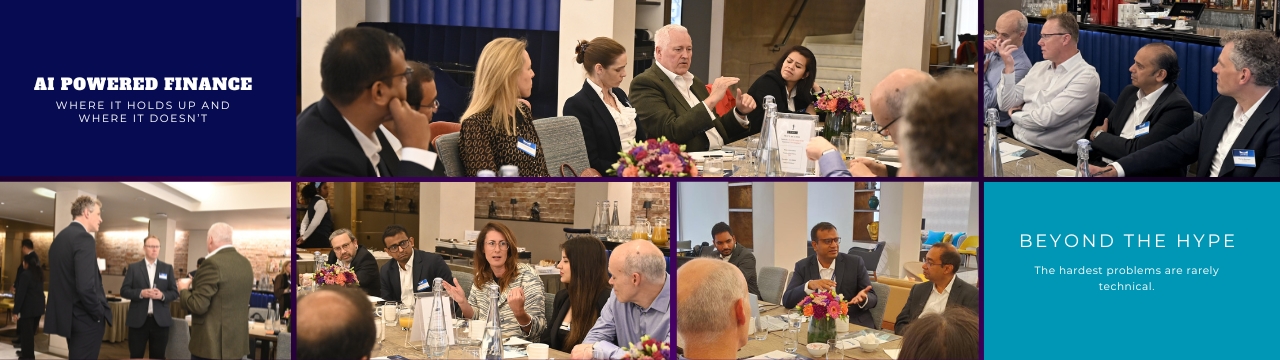
On 10 June 2026, LatentBridge hosted an invitation-only executive breakfast roundtable at One Moorgate Place in the City of London, bringing together senior finance leaders, transformation executives and AI practitioners from leading financial institutions across the UK.
Against a backdrop of accelerating technological change and growing expectations from boards and shareholders, the discussion focused on a simple but increasingly important question:
How can finance organisations realise meaningful value from AI while maintaining the trust, governance and rigour upon which the function depends?
The conversation was candid, practical and refreshingly grounded in operational realities.
Rather than debating whether AI has a place in finance, participants explored how organisations are approaching implementation, where meaningful value is already being realised, and what challenges leaders continue to navigate as adoption accelerates.
The roundtable brought together perspectives from organisations at different stages of their AI journey. Some had already deployed AI within selected finance processes, while others were actively evaluating where and how to begin. Despite these differences, several common themes emerged.
Finance leaders are moving beyond pilots driven by curiosity. The focus is increasingly on identifying use cases that create measurable business value, supported by clear governance and realistic success metrics.
Many organisations continue to grapple with fragmented systems, inconsistent data and manual processes that have evolved over time. AI often exposes these operational challenges rather than solving them outright.
Participants shared examples of AI helping finance teams improve reconciliation outcomes by interpreting context and identifying patterns that traditional rule-based approaches struggle to detect.
Natural language interfaces and AI-enabled analytics are making it easier for business leaders to access information quickly, reducing reliance on manual reporting cycles and enabling faster decision-making.
One of the most thought-provoking discussions centred on the shift from responding to questions raised by the business towards proactively surfacing opportunities, risks and emerging trends before they become obvious.
Accuracy, explainability and human oversight continue to be fundamental requirements, particularly in highly regulated environments. Participants agreed that trust cannot be compromised in pursuit of speed.
As AI adoption grows, organisations must establish clear guardrails around approved tools, data usage and validation practices to ensure innovation occurs responsibly.
The discussion acknowledged the workforce implications associated with greater automation. While opinions differed on the extent of change, there was broad agreement that transparent communication, capability building and thoughtful leadership will shape successful transitions.
Rather than pursuing dozens of disconnected pilots, participants highlighted the importance of prioritising a small number of high-impact use cases and embedding them effectively within existing workflows.
Perhaps the strongest theme to emerge from the session was that AI is prompting organisations to rethink what they expect from finance. Stewardship and control remain essential, but finance is increasingly being called upon to provide foresight, challenge assumptions and contribute more directly to strategic decision-making.
While the roundtable did not seek to produce a universal roadmap, it reinforced that organisations are asking increasingly sophisticated questions about the future of finance.
The discussion reflected both optimism and realism. There was enthusiasm about the opportunities AI presents, balanced by an appreciation of the operational, cultural and governance considerations required to translate potential into meaningful impact.
Most importantly, it highlighted the value of creating spaces where leaders can share experiences openly, challenge prevailing assumptions and learn from one another.
LatentBridge extends its sincere thanks to all those who joined the discussion and contributed their perspectives.
As organisations continue to navigate the next chapter of finance, conversations such as these will remain essential in shaping how innovation is applied thoughtfully, responsibly and with lasting impact.
We look forward to continuing the dialogue.