

At A Glance
- Start with the business outcome, not the AI use case.
- Focus investment on a few strategic “Big Rocks” with clear ownership and measurable value.
- Understand and redesign the real workflow before deciding what to automate.
- Design AI and human roles around exceptions, judgement and accountability.
- Build governance, evidence and traceability into execution from the start.
- Measure success by what changes in production, not by pilot activity or model performance alone.
AI investment in financial services is entering a more demanding phase.
Institutions have spent the past several years testing what AI can do. The harder decisions now concern where that capability should create measurable business value, who should own the outcome, and what needs to change around the workflow to make that value real.
That puts the discussion on a more practical foundation: revenue, customer outcomes, risk, capacity, cost and control.
The recent conversation among financial services leaders reinforced a view we at LatentBridge have been building into how we approach AI delivery. Value is rarely determined by the model alone. It depends on the problem selected, the process around it, the people accountable for it, and the discipline required to take it into production.
Four implications stand out.
AI investment needs a business owner and a measurable outcome.
Financial institutions have experimented extensively with AI. The next challenge is deciding which opportunities deserve sustained investment.
The discussion highlighted the limitations of the “50 lighthouse projects” approach. A large portfolio of pilots can create activity without producing enough material change. The emerging direction is towards a smaller number of strategic “Big Rocks” with senior business ownership, measurable outcomes, sufficient workflow scope and a credible path to production.
For us, that changes the starting point for delivery.
We should not begin by asking which AI use case to build. We should begin by asking what the institution needs to improve and whether the problem is significant enough to justify changing the underlying workflow.
A business outcome should have an owner before it has an AI solution.
The workflow needs to be understood before the automation is designed.
Several participants pointed to a constraint that has little to do with access to the latest model. The harder problem is integrating AI into existing systems, data environments and workflows.
That distinction matters because the biggest opportunity may sit across an entire process rather than inside a single task.
There was also a simple question raised during the discussion: “Does your SOP actually do everything and show everything that people are doing?”
Often, it does not. The real process may include spreadsheets, manual checks, email handoffs, exceptions and decisions that exist only as institutional knowledge.
For LatentBridge, that means going beyond traditional requirements gathering. We need to understand how work actually happens, redesign how it should happen, and only then determine where AI, existing automation and people should each contribute.
Automation needs a deliberate exception path.
Once the real workflow is understood, the next question is how much of it should actually be automated.
Several participants returned to the same concern: applying AI to an inefficient process can accelerate the process without fixing the underlying problem. For many regulated workflows, the stronger approach is to automate the normal path while deliberately engineering for exceptions.
That means defining where uncertainty is identified, when the system should abstain, what evidence is required, and when a specialist needs to take over.
The same principle applies to human oversight. A person added to the end of an automated workflow is not automatically an effective control. If every action requires full human re-analysis, the person becomes the bottleneck. If the volume of AI output exceeds what they can realistically assess, review can become superficial.
For LatentBridge, the boundary between AI and human judgement therefore needs to be defined within the workflow itself. The system should know what it can handle, where it needs to stop, and when a person needs to intervene.
Control has to be designed into execution.
For financial institutions, governance cannot sit outside the workflow.
As AI takes on more responsibility, the workflow needs to carry evidence, provenance, permissions, validation, monitoring, escalation and accountability with it. The discussion reinforced the case for assurance by design: evidence, permissions, validation and traceability should be built into the workflow rather than reconstructed later for audit or review.
This also gives us a clearer view of what implementation should look like.
For regulated workflows, we need architecture that can establish bounded authority, separation of duties, independent validation and traceability. The specific design will vary by process, but control needs to be considered alongside the workflow and AI roles from the beginning.
That is the difference between deploying an AI capability and building something an institution can actually operate.
The measure of success is what changes in production.
The common thread across all four areas is accountability.
If the objective is revenue, did revenue improve? If it is customer experience, did the process improve for the customer? If it is risk, did the institution improve its ability to identify and manage that risk? If the goal is capacity or cost, did the economics change?
Model performance, user numbers and pilot activity can be useful indicators. They are not the business outcome.
For LatentBridge, this sharpens the delivery sequence: define the outcome, select the Big Rock, assign ownership, understand the real workflow, redesign it, decide where AI and people belong, build controls into execution, and measure what changes in production.
The technology will continue to move quickly. The discipline around where and how institutions apply it will determine how much of that progress becomes enterprise value.
The questions behind the discussion
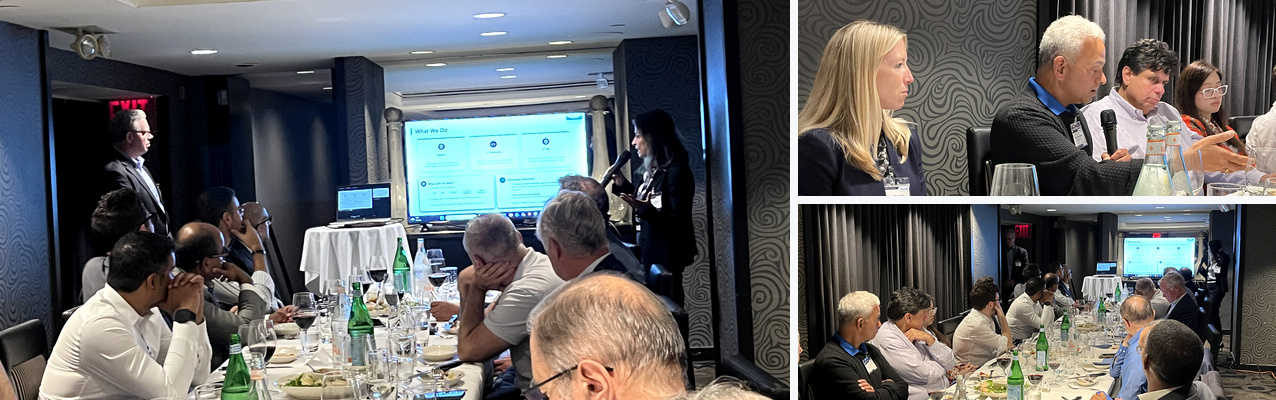
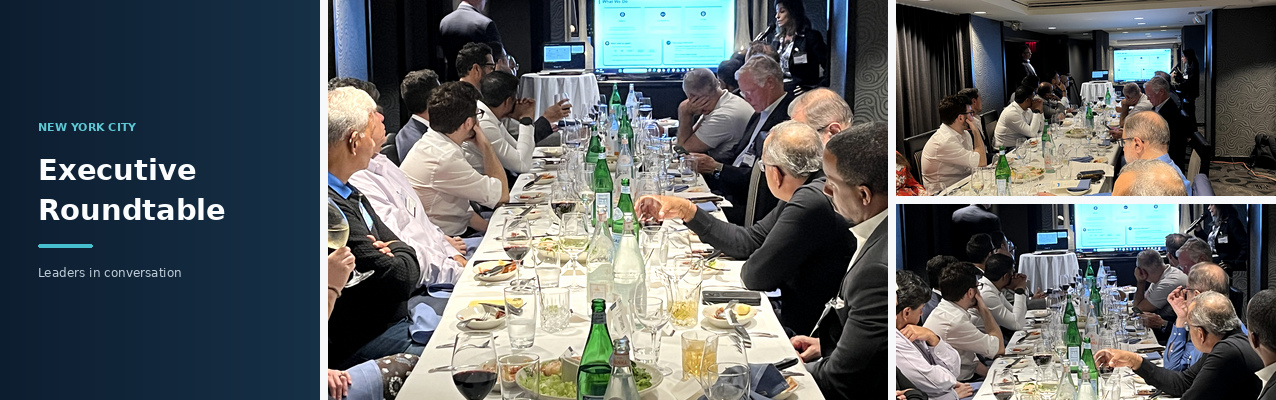
These ideas were explored at LatentBridge’s New York Executive Dinner Roundtable, The Outcome Imperative: Moving AI from Capability to Enterprise Performance, held on September 17, 2026.
The invitation-only discussion brought together 20+ senior leaders from global banking and financial services, with the conversation led by Hema Gandhi, Founder and CEO of LatentBridge; Kosta Haritakis, Managing Director and Global Head of AI at Mizuho; and Julian Mason, Head of Investment Banking & Payments GTM at Anthropic.
Attendees received The Outcome Imperative: Capital, Control and the New AI Operating Model in Financial Services handbook ahead of the dinner. The handbook established the broader thesis; the roundtable tested those ideas against the realities of AI adoption, workflow redesign, enterprise economics, governance and organisational change.