



At A Glance
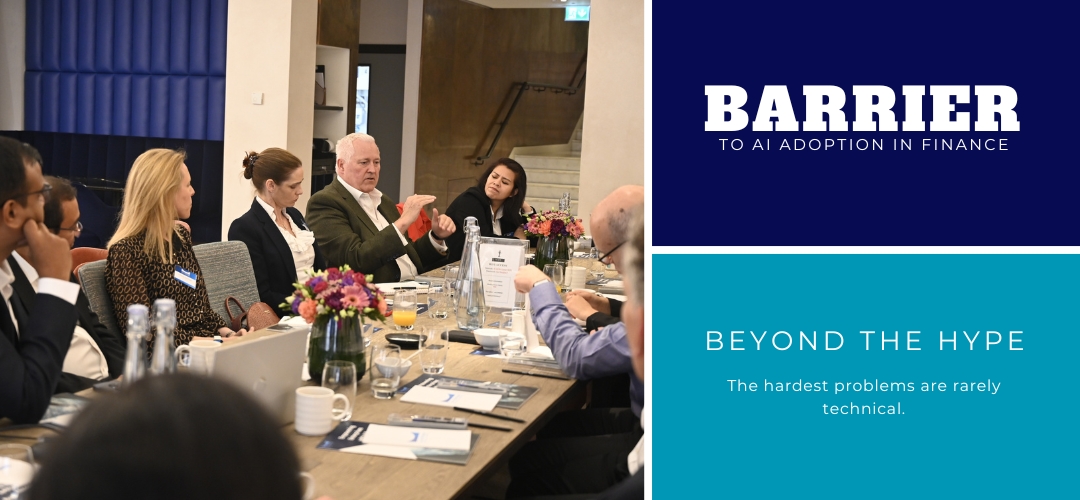
What this is: Insights from a closed-door roundtable hosted by LatentBridge on 10 June 2026, bringing together CFOs, Finance Controllers and AI transformation leaders from major financial institutions across the UK.
The central finding: AI adoption in finance is no longer a question of whether, but how. The organisations making genuine progress are not those moving fastest or running the most pilots. They are those asking more disciplined questions about data readiness, governance and what finance is actually for.
Key themes covered:
- Why process debt, not technology, is the primary barrier to AI adoption
- Where AI is already delivering measurable value: reconciliation, FP&A, contract extraction and cash collection
- The shift from reactive reporting to proactive, push-based intelligence
- How to manage fraud risk, data integrity and the human-in-the-loop imperative
- What CFOs should prioritise to move from experimentation to execution
What CFOs and finance leaders are discovering as AI moves from experimentation to execution
LatentBridge Finance Roundtable | One Moorgate Place, City of London | 10 June 2026
The most revealing aspect of a recent discussion among senior finance leaders in London was not what was said about artificial intelligence.
It was what was not said.
No one questioned whether AI belonged in finance. No one debated whether it was another passing trend. There was little interest in comparing models, vendors or platforms. The conversation did not revolve around who was using Claude, ChatGPT, Copilot or the latest specialist solution.
Instead, the discussion centred on a more difficult set of questions.
How do organisations preserve trust while accelerating innovation? How do leaders determine where AI can genuinely create value, and where it cannot? How do they prepare their teams for a future that feels both exciting and uncertain? What happens to the role of finance when information becomes easier to access, analyse and distribute?
These observations emerged during a closed-door roundtable hosted by LatentBridge on 10 June 2026 at One Moorgate Place in the City of London, bringing together CFOs, Finance Controllers and AI transformation leaders from major financial institutions across the UK. Although participants represented different sectors and varying stages of maturity, a striking degree of alignment emerged.
The conversation around AI in finance has entered a new phase.
The debate is no longer about possibility.
It is about execution, judgement and the evolving purpose of the finance function itself.
AI in finance has moved past the pilot stage — so why are so many organisations still stuck?
Over the past two years, many organisations approached AI through isolated pilots and controlled experiments. Success was often measured by novelty rather than business impact. The prevailing question was simple: can we do something with this technology?
That question has now evolved.
Finance leaders are increasingly asking where AI should be applied, how it should be governed, and how success ought to be measured. Discussions that once revolved around technological capability now focus on operational reality.
Participants were not searching for more use cases. If anything, several warned against the temptation to pursue AI simply because competitors appeared to be doing so. Fear of missing out can be a powerful driver, but rarely an effective strategy.
Shareholders are not demanding AI because they are fascinated by the technology itself. They expect organisations to improve performance, strengthen resilience and create new sources of value. AI is merely one means through which those outcomes may be achieved.
That distinction matters.
It shifts the conversation from tools to objectives, and from experimentation to execution.
The organisations making progress are not necessarily those running the highest number of pilots. They appear to be those asking more disciplined questions about priorities, readiness and measurable outcomes.
The biggest barrier to AI adoption in finance is not the technology
One of the strongest themes to emerge from the discussion was that many of the obstacles preventing organisations from realising value have very little to do with AI itself.
They are rooted in years of accumulated operational complexity.
Manual reconciliations continue to consume significant time and effort. Teams remain heavily dependent on spreadsheets. Data often resides across fragmented systems developed through acquisitions, legacy investments and local workarounds. Multiple versions of the truth coexist within the same organisation.
Processes that function adequately under human intervention reveal their limitations when organisations attempt to automate them.
In many respects, AI acts as an unforgiving mirror.
It exposes process debt that organisations have quietly learned to tolerate.
Several participants described initiatives stalling not because the models underperformed, but because the underlying architecture could not support them. The logic is straightforward: AI is, at its core, a pattern-recognition and inference engine. If the patterns in your data reflect human error, inconsistent coding or fragmented system architecture, the AI will find those patterns and present them as insight.
Garbage in, garbage out remains as true as it ever was. In fact, it may be more dangerous when the output carries the apparent authority of a machine.
The practical implication is that AI implementation in finance often becomes a two-stage exercise.
The first stage is unglamorous: auditing data quality, resolving inconsistencies and addressing the workarounds accumulated over years of system evolution.
The second stage, transforming finance into a genuinely strategic function, becomes possible only once those foundations are in place.
This is not a popular message in an environment where markets are demanding accelerated adoption.
It is, however, the honest one.
Where AI is creating real value in finance right now
Despite the caveats, the discussion surfaced several practical applications where AI is already delivering measurable outcomes, without requiring a fully transformed data architecture to do so.
AI for finance reconciliation. The canonical challenge is intercompany reconciliation across large entity structures, where one entity records a transaction as "books and pens" and another records it as "stationery." Traditional deterministic automation fails because it cannot interpret context. AI introduces contextual understanding, matching transactions that share amounts, dates and implied meaning even when descriptions differ. Participants reported match rates of around 80 per cent using AI, compared to 35 to 40 per cent with rule-based approaches. One organisation described a tool that had resolved over a million mismatched transactions, identified the root causes of error, and produced exception reports enabling the team to address systemic problems rather than individual anomalies.
AI for contract data extraction. Finance teams often struggle to reconcile hundreds of non-standard agreements against related cash flows, particularly at audit. Each contract carries its own structure, terminology and commercial nuances. AI's ability to extract, normalise and interpret this information offers a compelling alternative to manual review.
AI for FP&A and variance analysis. Several participants described using AI to generate variance narratives, incorporating both internal data and external factors such as commodity movements, currency fluctuations and macroeconomic developments. One finance leader described using AI as an alternative perspective, asking it to review reports through the eyes of a sceptical board member and identify questions that might arise before entering the boardroom.
AI for financial data democratisation. Business leaders increasingly expect immediate answers rather than waiting for reports. Natural language interfaces allow managers to ask simple questions such as "How much revenue are we generating from this client?" without relying on FP&A teams to generate bespoke analysis. The value extends beyond efficiency. It improves the quality and timeliness of decision-making itself.
AI for accounts receivable and cash collection. AI agents can now automate the identification of overdue accounts and generate contextually appropriate collection communications. One participant described converting an accounts receivable function from a cost centre into a value-generating operation through exactly this kind of automation, recovering meaningful cash flow improvements without additional headcount.
How AI is shifting finance from reactive reporting to proactive intelligence
Among the most thought-provoking themes was the changing direction of information flow.
Historically, the business has pulled information from finance.
A question arises. A report is requested. Analysis follows.
The future model may look very different.
AI-enabled finance functions can proactively push insights to the business before questions are asked. Anomalies can be flagged automatically. Emerging risks can be highlighted early. Commercial opportunities can be prioritised and surfaced to relevant stakeholders before they become obvious.
One participant shared a precise example involving foreign exchange movements. Rather than expecting relationship managers to identify affected clients manually, the system automatically generated a prioritised list based on market movements, client exposure, historical behaviour and potential opportunity. The human still made the call. The AI simply ensured they knew whom to call, why and in what order.
This distinction may represent one of the most significant shifts emerging within finance.
It moves the function beyond responding to requests.
It positions finance as a proactive contributor to business outcomes.

How AI is transforming FP&A: from production to interpretation
While much of the early value from AI in finance has emerged in back-office cycles, FP&A is experiencing its own significant shift.
Automated variance narratives, proactive anomaly detection and scenario generation are allowing teams to spend less time producing analysis and more time interpreting it. Rather than building the deck, finance professionals are being asked to challenge it, contextualise it and use it to drive decisions.
This is not a marginal improvement in efficiency. It is a change in what FP&A teams are actually for.
Several participants described using AI to incorporate external signals directly into variance commentary: commodity price movements, currency shifts, geopolitical developments. Others spoke about using AI as a structured challenger, asking it to review a finished report from the perspective of a sceptical board member and surface the questions they had not yet anticipated.
The implication is meaningful for finance leaders thinking about where to invest in AI. FP&A may have less obvious automation potential than reconciliation or cash collection, but its transformation may ultimately deliver more strategic value. When the analysis writes itself, the finance function is free to do what it was always supposed to do: think.
AI governance, data integrity and fraud risk in financial services
If optimism characterised parts of the discussion, it was consistently balanced by realism.
Trust emerged repeatedly as a defining concern, particularly in regulated environments where decisions influence investors, customers, regulators and broader organisational outcomes. Accuracy is non-negotiable.
Participants raised concrete concerns: AI hallucinations generating plausible but incorrect outputs, synthetic documents passing visual inspection, and AI-enabled fraud growing in sophistication. Deepfake video combined with spoofed email instructions to authorise transfers. Multi-channel social engineering attacks designed to create urgency that overrides normal process controls.
The defence, the group agreed, is not primarily technological. It is procedural.
Organisations with strong anti-fraud postures share several characteristics: they treat process adherence as non-negotiable regardless of seniority, require multi-point validation for high-value transactions, and invest continuously in staff awareness. Trusted data sources must be whitelisted and triangulated. Established controls should not be bypassed simply because an answer arrives faster.
There was no rejection of technology in these observations. There was recognition that trust cannot be compromised in pursuit of speed.
The future is unlikely to be fully autonomous. It is far more likely to be collaborative. AI may identify patterns, surface recommendations and challenge assumptions. Human judgement determines how those insights are interpreted and acted upon.
Finance has spent decades building confidence through discipline, rigour and accountability.
Those principles remain unchanged.
Why AI strategy in finance should go deep, not wide
The enthusiasm for AI adoption has produced a secondary problem: ungoverned proliferation.
In several organisations, creative individuals have built their own AI solutions to address local pain points. The tools work, in a narrow sense. But they do not scale, they introduce security and data privacy risks, and they create a fragmented landscape that becomes progressively harder to manage.
Effective AI strategy in finance, the roundtable concluded, is not about going wide. It is about going deep in the right places.
Cost is a genuine constraint that reinforces this point. The economics of token-based AI services can deteriorate quickly when adoption is unfocused. Organisations that have deployed AI broadly without a clear prioritisation framework have found that subscription and token costs become significant before the value case is established.
Identifying the highest-pain use cases, embedding AI properly into those workflows, and generating real demonstrable value is more effective than seeding dozens of pilots that never reach production.
The human side of AI transformation in finance
Perhaps the most candid moments emerged when the discussion turned to people.
The question was unavoidable.
What happens to jobs?
There were no simplistic answers.
Some participants argued that efficiencies are inevitable. Transaction-heavy functions will require fewer people over time. Pretending otherwise risks undermining trust. Others focused on opportunity. If finance professionals spend less time reconciling transactions, preparing reports and gathering information, they can devote greater attention to planning, analysis, business partnering and strategic decision-making.
Both perspectives can coexist.
What united the discussion was the recognition that leadership matters more than certainty.
People rarely resist technology in isolation. They resist uncertainty about what the technology means for them. As several participants observed, organisations have navigated similar moments before through outsourcing, offshoring and robotic process automation. The underlying principles remain familiar. Leaders must communicate clearly, establish realistic expectations and help employees understand how their roles may evolve.
And they must equip people with the skills required to succeed.
A new divide is emerging.
It is not between humans and machines. It is increasingly between those who know how to work alongside AI and those who do not.
.png)
What CFOs should do now: a practical AI adoption framework for finance
The roundtable produced no universal roadmap. Nor should it have. Every organisation operates within different constraints, priorities and regulatory environments.
Yet beneath the differences, a common mindset emerged among the leaders making genuine progress. They are not necessarily moving fastest, nor pursuing the greatest number of pilots. They are asking better questions. They recognise that process maturity and governance are prerequisites rather than afterthoughts.
Several practical conclusions emerged consistently across the session.
Start with the data. AI amplifies what is already there. If the underlying data is unreliable, the transformation work must come first.
Be honest about the human implications. Redeployment into higher-value roles is a real and worthwhile goal, but it requires genuine investment in retraining. FOMO-driven adoption that bypasses this work creates more problems than it solves.
Prioritise depth over breadth. Two or three use cases that are deeply embedded and generating clear value are worth more than twenty pilots that never reach production.
Establish governance early. Individual AI experiments that lack oversight become security risks and create technical debt. Clear guidelines on approved tools, data access and validation requirements protect the organisation and build the trust required for broader adoption.
Reframe the conversation internally. AI positioned as a cost-cutting exercise will encounter resistance. AI positioned as a way to make finance more strategically valuable, and to make individual contributors less burdened by low-value work, is easier to adopt and more likely to succeed.
The future of the finance function
The finance function as a reactive cost centre, producing reports on request and reconciling transactions in spreadsheets, is a model with a limited future.
As transactional effort recedes and insight becomes more accessible, finance has an opportunity to expand its influence in ways previously constrained by capacity. The function emerging in its place is proactive, predictive and genuinely integrated into strategic decision-making. AI is the mechanism of that transition, but it is not sufficient on its own. Leadership, data quality, governance and a serious commitment to developing people are equally necessary.
For decades, finance has been defined by stewardship.
That responsibility remains indispensable.
But stewardship alone may no longer define the function.
The question facing finance leaders is therefore not whether AI will change the function.
It already is.
The more important question is whether organisations are prepared to redefine what they expect finance to become.
Because the greatest opportunity presented by AI may not be doing the same work faster.
It may be creating the conditions for finance to become a more influential partner in shaping the decisions that determine organisational success.
LatentBridge works with finance leaders to embed AI into operational workflows, focusing on measurable outcomes rather than experimentation. If the themes in this piece resonate with challenges you are navigating, we would welcome the conversation.
This article draws on discussion from the LatentBridge Finance Roundtable, held on 10 June 2026 at One Moorgate Place, City of London. LatentBridge invited CFOs, Finance Controllers and AI transformation leaders from major financial institutions across the UK to examine the practical and strategic realities of AI adoption in finance. To discuss how LatentBridge can help your organisation navigate this transition, get in touch at latentbridge.com.